Kategória: Természettudomány

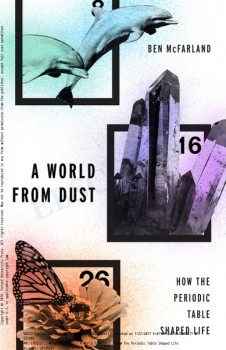
A World From Dust : How the Periodic Table Shaped Life

A World From Dust describes how a set of chemical rules combined with the principles of evolution in order to create an environment in which life as we know it could unfold. Beginning with simple mathematics, these predictable rules led to the advent of the planet itself, as well as cells, organs and organelles, ecosystems, and increasingly complex life forms. McFarland provides an accessible discussion of a geological history as well, describing how the inorganic matter on Earth underwent chemical reactions with air and water, allowing for life to emerge from the world’s first rocks. This book includes 40 illustrations by Gala Bent, print artist and studio faculty member at Cornish College of the Arts, and Mary Anderson, medical illustrator.

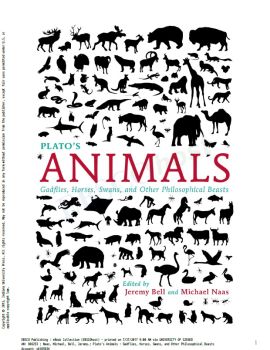
Plato’s Animals : Gadflies, Horses, Swans, and Other Philosophical Beasts

Plato’s Animals examines the crucial role played by animal images, metaphors, allusions, and analogies in Plato’s Dialogues. These fourteen lively essays demonstrate that the gadflies, snakes, stingrays, swans, dogs, horses, and other animals that populate Plato’s work are not just rhetorical embellishments. Animals are central to Plato’s understanding of the hierarchy between animals, humans, and gods and are crucial to his ideas about education, sexuality, politics, aesthetics, the afterlife, the nature of the soul, and philosophy itself.

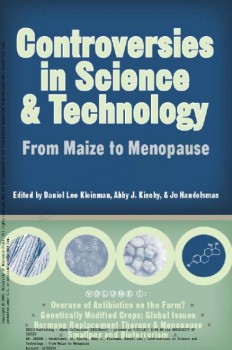
Controversies in Science and Technology : From Maize to Menopause

Written for general readers, teachers, journalists, and policymakers, this volume explores four controversial topics in science and technology, with commentaries from experts in such fields as sociology, religion, law, ethics, and politics: • Antibiotics and Resistance, Genetically Modified Maize and Gene Flow, Hormone Replacement Theory and Menopause, Smallpox

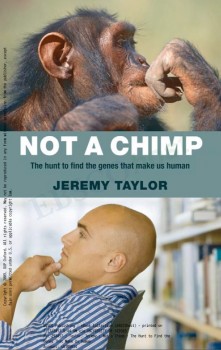
Not a Chimp : The Hunt to Find the Genes That Make Us Human

Certainly chimps are our closest genetic relatives. But relatively small differences in genetic code can lead to profound differences in cognition and behaviour. Our abilities give us the responsibility to protect and preserve the natural world, including endangered primates. But for the purposes of human society and human concepts such as rights, let’s not pretend that chimps are humans uneducated and undressed. We’ve changed a lot in those 12 million years.

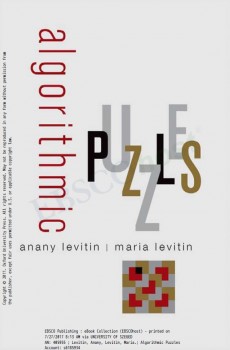
Algorithmic Puzzles

While many think of algorithms as specific to computer science, at its core algorithmic thinking is defined by the use of analytical logic to solve problems. This logic extends far beyond the realm of computer science and into the wide and entertaining world of puzzles. In Algorithmic Puzzles, Anany and Maria Levitin use many classic brainteasers as well as newer examples from job interviews with major corporations to show readers how to apply analytical thinking to solve puzzles requiring well-defined procedures.

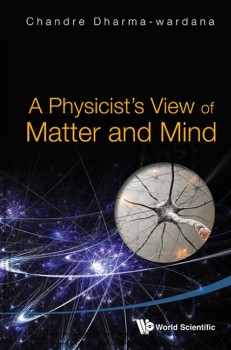
A Physicist’s View Of Matter And Mind

This is a highly interdisciplinary book straddling physics and complex systems such as living organisms. The presentation is from the perspective of physics, in a manner accessible to those interested in scientific knowledge integrated within its socio-cultural and philosophical backgrounds. Two key areas of human understanding, namely physics and conscious complex systems, are presented in simple language.

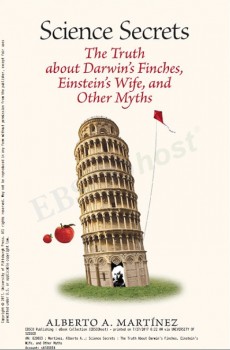
Science Secrets : The Truth About Darwin’s Finches, Einstein’s Wife, and Other Myths

Was Darwin really inspired by Galápagos finches? Did Einstein’s wife secretly contribute to his theories? Did Franklin fly a kite in a thunderstorm? Did a falling apple lead Newton to universal gravity? Did Galileo drop objects from the Leaning Tower of Pisa? Did Einstein really believe in God? Science Secrets answers these questions and many others. It is a unique study of how myths evolve in the history of science. Some tales are partly true, others are mostly false, yet all illuminate the tension between the need to fairly describe the past and the natural desire to fill in the blanks.

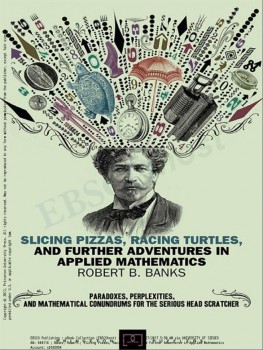
Slicing Pizzas, Racing Turtles, and Further Adventures in Applied Mathematics

Have you ever daydreamed about digging a hole to the other side of the world? Robert Banks not only entertains such ideas but, better yet, he supplies the mathematical know-how to turn fantasies into problem-solving adventures. In this sequel to the popular Towing Icebergs, Falling Dominoes (Princeton, 1998), Banks presents another collection of puzzles for readers interested in sharpening their thinking and mathematical skills. The problems range from the wondrous to the eminently practical. In one chapter, the author helps us determine the total number of people who have lived on earth; in another, he shows how an understanding of mathematical curves can help a thrifty lover, armed with construction paper and scissors, keep expenses down on Valentine’s Day.

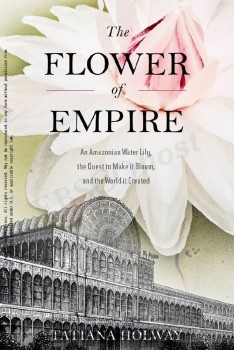
The Flower of Empire : An Amazonian Water Lily, The Quest to Make It Bloom, and the World It Created

In 1837, while charting the Amazonian country of Guiana for Great Britain, German naturalist Robert Schomburgk discovered an astounding’vegetable wonder’–a huge water lily whose leaves were five or six feet across and whose flowers were dazzlingly white. In The Flower of Empire, Tatiana Holway tells the story of this magnificent lily, revealing how it touched nearly every aspect of Victorian life, art, and culture. Holway’s colorful narrative captures the sensation stirred by Victoria regia in England, particularly the intense race among prominent Britons to be the first to coax the flower to bloom.

The Science of Cooking : Understanding the Biology and Chemistry Behind Food and Cooking

Each chapters begins with biological, chemical, and /or physical principles underlying food topics, and a discussion of what is happening at the molecular level. This unique approach is unique should be attractive to chemistry, biology or biochemistry departments looking for a new way to bring students into their classroom.